FHSU grad student Ernestina Osei turns research into positive community impact
5/11/26
By FHSU University Communications
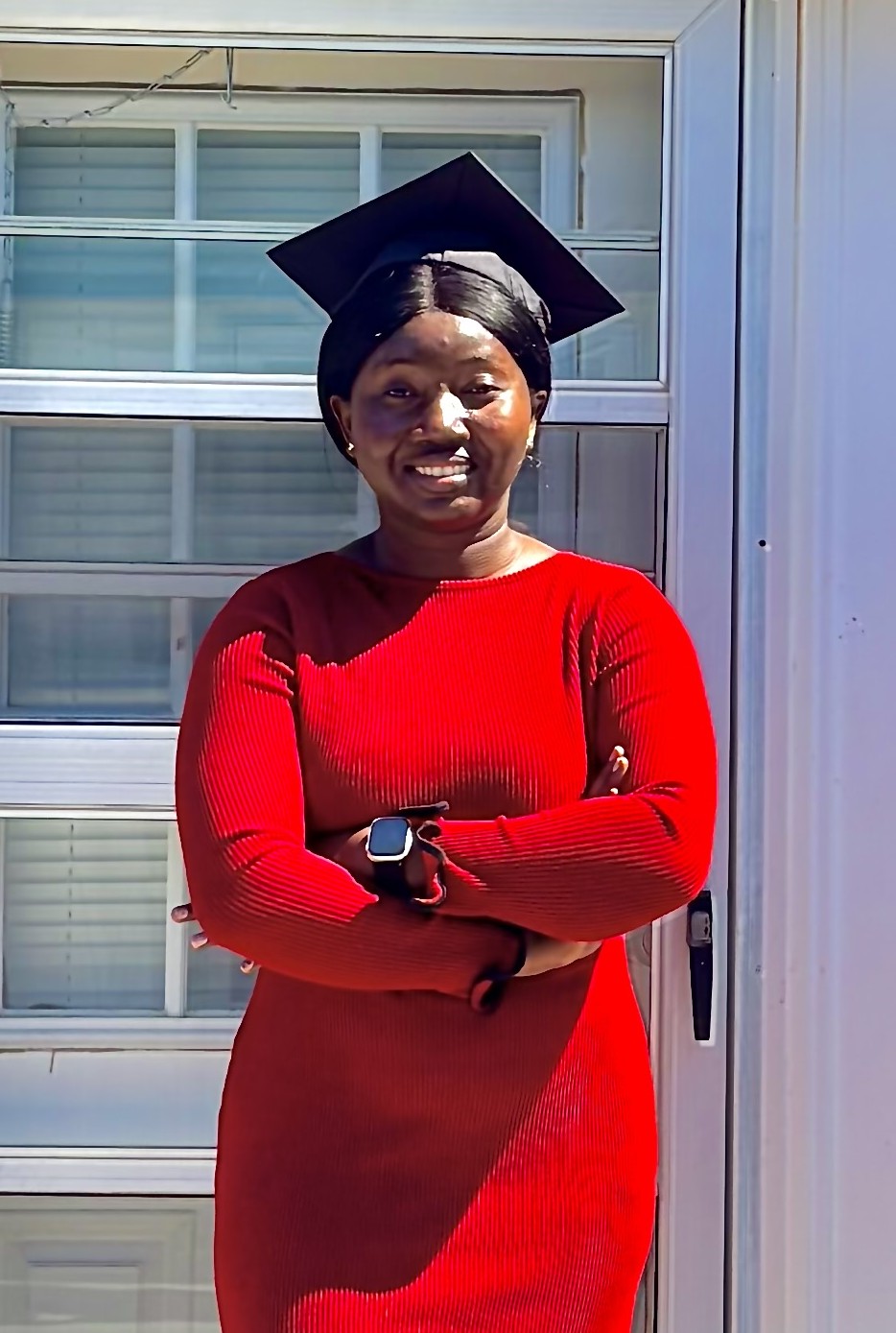
HAYS, Kan. – When Ernestina Osei began exploring graduate school opportunities from her home country of Ghana, she had one clear goal: to deepen her expertise and specialize in a field she was already passionate about. This semester, as she completes her Master of Science in Geosciences at Fort Hays State University (FHSU), Osei is celebrating not only the achievement of that goal, but a graduate journey marked by impactful research, professional service to the Hays community, and a clear vision for her future in geospatial science.
“I’ve always wanted to earn a graduate degree with a specialization in an area I enjoy,” Osei said. That desire ultimately led her across continents to FHSU, where she pursued advanced training with an emphasis in Geographic Information Systems (GIS).
Osei holds a bachelor’s degree in geography from Kwame Nkrumah University of Science and Technology in Kumasi, Ghana. While researching U.S. graduate programs, she came across Fort Hays State and reached out directly to faculty. One email in particular changed the trajectory of her academic career.
“I emailed one of the advisors, Dr. Richard Lisichenko, and he wanted to work with me,” she said. “So I applied, and I got into the school.”
Now finishing her degree after nearly two years in Kansas, Osei reflects on a graduate experience that blended rigorous academic research with real-world application — precisely what she hoped to find when she began her search.
At FHSU, Osei specialized in GIS, a field that uses spatial data and mapping technologies to analyze complex geographic and social issues. For her master’s research, she focused on social vulnerability in urban environments, using Detroit, Michigan, as her primary study area.
“I was identifying areas of concern based on certain parameters like social vulnerability and how close they are to important services,” Osei explained.
Using specialized software, ESRI’s ArcGIS Pro, Osei combined datasets from the American Community Survey to analyze factors such as poverty, housing vacancy rates, and access to essential services, including hospitals, fire stations, and other infrastructure. By layering and analyzing these variables spatially, she was able to identify neighborhoods with significantly higher levels of vulnerability.
“This is to inform planners in case they want evidence as to how they can better allocate resources,” Ernestina said.
Beyond fulfilling degree requirements, Osei’s research addresses challenges faced by many aging urban centers in the United States. She plans to expand this line of inquiry in the future by incorporating water infrastructure and quality data, an area of particular relevance for cities such as Detroit.
“I plan in the future to bring in the water component to be able to really assess the needs of this area,” she said.
Osei’s research efforts culminated in a successful thesis defense at FHSU and a national conference presentation at the American Association of Geographers meeting in San Francisco, marking a major professional milestone early in her career.
In addition to her academic research, Osei applied her GIS expertise in a hands-on professional setting through her work with the City of Hays. Beginning in August 2025, she collaborated with city staff to modernize and streamline infrastructure data systems, work that will continue to benefit the community long after her graduation.
Her first project involved digitizing roads, alleys, and private driveways that were not yet included in the city’s GIS system.
“That will help emergency response teams,” she said, noting that accurate mapping is essential during emergencies when response time and route accuracy are critical.
Osei later took on a second, more complex project focused on the city’s fire hydrants. Prior to her involvement, hydrant inspections were tracked across multiple spreadsheets, making it difficult to identify inspection gaps or retrieve historical data efficiently.
“Previously, they were using Google Sheets, and it made it very cumbersome because there were so many Excel sheets,” she said.
Working with a colleague, Osei helped develop an interactive GIS dashboard and a Google Field Maps application. The new system allows field crews to click directly on a hydrant within a map-based app, complete inspection forms in real time, and automatically update a centralized dashboard.
“It has the map on it with the hydrants, and you can just click on any hydrant on the app, and you can start filling in the form,” she said. “So, it makes it very seamless.”
Dr. Richard Lisichenko, Professor and Chair of the Department of Geosciences at FHSU and Osei’s major advisor, praised her academic achievements, work ethic, and impact.
“Ernestina is an outstanding example of what our graduate students can accomplish when strong technical ability is paired with motivation and purpose,” Lisichenko said. “She applied sophisticated GIS methods to address real societal challenges, and she brought that same level of professionalism and innovation to her work with the City of Hays. We are incredibly proud of her accomplishments and excited to see what she will achieve next.”
After graduation, Osei will continue her academic journey at Kansas State University, where she has been accepted into the Ph.D. program in geography and geospatial sciences.
Long term, she hopes to work in industry while continuing applied research, ideally with ESRI, the same company whose software formed the backbone of her graduate work.
“One of my dream companies to work with is the ESRI Corporation,” Osei said. “The company that produces the software that we use.”
Wherever her career leads, Osei remains open to opportunities both in the United States and back home in Ghana, where she maintains strong cultural and family ties.
As she crosses the graduation stage at Fort Hays State University, Ernestina Osei leaves behind a legacy of meaningful research, lasting community contributions, and a clear reminder of the global perspectives international students bring to campus and to Kansas.