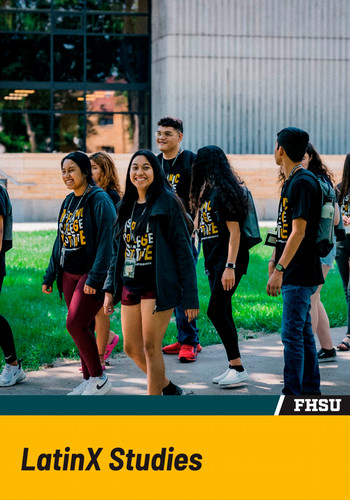
Certificate in Latine/x Studies
Hours: 12 Online
The Certificate in Latine/x Studies is a 12-credit online credential offered by Fort Hays State University. It is intended for individuals of Latine/x or Hispanic descent, as well as those seeking to deepen their understanding of these cultures.
This certificate complements degrees in sociology and related fields by enhancing cultural competency and fostering a deeper understanding of the fastest-growing ethnic population in the United States.
Participants will engage in interdisciplinary coursework that explores the cultural, social, and historical dimensions of Latino communities. The fully online format offers flexibility, making it accessible to both working professionals and students.
Who is this program for?
This certificate is ideal for individuals who:
- Are of Latine/x or Hispanic descent
- Work in multicultural settings
- Pursue careers in social services or education
- Seek to enhance cultural competency
- Are sociology majors or related fields
- Aim to understand the fastest-growing ethnic population in the U.S
The Best Value in Higher Education Anywhere
Fort Hays State University prides itself on quality education at an affordable price. Students in this program can expect to pay approximately $3,307.80* (online) per semester.
*Estimated cost based on 12 credit hours at the FHSU Online Undergrad tuition rate ($275.65/credit hour) for online courses. Actual price may vary depending on course load and location. Tuition and Fees are subject to change as they are approved by the Kansas Board of Regents each year.
The core curriculum includes a minimum of 12 credit hours focused on the cultural, social, and historical dimensions of Latine/x communities. Students explore a variety of topics while tailoring their studies to fit personal interests and career goals.
Courses cover cultural diversity, social dynamics, and historical contexts, while building essential research and communication skills for multicultural settings. The certificate’s interdisciplinary structure offers a well-rounded academic foundation for careers in education, social services, public policy, and community engagement.
Upon completion, students will be equipped with the knowledge and practical skills to navigate complex cultural issues and contribute meaningfully to professional and community contexts.
SOC 348: Topics in Sociology
This course provides irregularly offered topics not covered in the regular curriculum. Refer to the semester class schedule for specific subjects.
HIST 350: Latin American Civilization
This course is a study of the pre-Columbian civilizations of the New World, the Spanish and Portuguese civilizations that conquered them, and the compromise civilizations that emerged.
HIST 636: The American Southwest
This course is an examination of the contributions of Indians, Hispanics, and the United States to the political, economic, social, and cultural growth of the American Southwest.
Discover the full Certificate in Latine/x Studies course listing by visiting the Academic Catalog.
The Certificate in Latine/x Studies enhances career prospects by providing cultural knowledge and practical skills for success in diverse, multicultural environments. Students who complete the certificate are well-prepared to contribute to fields such as education, social services, public policy, healthcare, and community outreach. Their understanding of Latine/x communities makes them valuable assets in today’s global workforce.
Social Services Specialist
Social services specialists work in community organizations serving Latine/x populations, developing and implementing programs that promote social justice and inclusion.
Cultural Competency Trainer
Cultural competency trainers design and deliver training on cultural diversity, helping organizations foster inclusive and respectful workplaces.
Public Policy Advisor
Public policy advisors analyze and advocate for policies affecting Latine/x communities, collaborating with agencies and nonprofits to promote equity and social justice.
Educator
Educators teach Latine/x studies and multicultural education, develop curricula, and support student learning and growth.
Community Outreach Coordinator
Community outreach coordinators lead programs supporting Latine/x communities by organizing events, managing volunteers, and collaborating with partner organizations.
Ready for the next step?
Our faculty would be excited to talk to you about how our department programs can help you explore your interests and prepare you for a variety of rewarding careers.
Related Programs
Students interested in the Certificate in Latine/x Studies may also consider:
- Certificate in Cultural Anthropology and Globalization
- B.A./B.S. in Sociology
- Minor in Sociology
- Bachelor of Social Work
Please refer to the FHSU tuition rates for the most current information.
Yes, this certificate is offered entirely online.
The certificate comprises 12 credit hours and can typically be completed in one year.
While there are no specific internships or field courses, the certificate includes interactive and applied learning experiences.
Students who complete the certificate can pursue careers in social services, education, public policy, cultural competency training, and community outreach.
Information about the School of Criminal Justice, Leadership and Sociology
The School of Criminal Justice, Leadership and Sociology at FHSU offers a diverse range of programs designed to prepare students for meaningful and impactful careers in law enforcement, leadership, and the social sciences. Through an integrated, interdisciplinary approach, students develop critical skills that equip them to address complex societal challenges and become effective leaders and professionals.
The Criminal Justice programs provide both online and on-campus options, focusing on areas such as law enforcement, corrections, and the legal system, with a strong emphasis on leadership, ethics, and integrity. Leadership programs cultivate essential organizational and interpersonal skills through interactive coursework and hands-on internships, supported by initiatives like the Leadership Studies Association and the VALUE program. Sociology programs explore human behavior, social structures, and community issues, encouraging analytical thinking and research-based problem-solving.
Together, these programs create a robust and collaborative educational environment that promotes cross-disciplinary learning. Students are empowered to lead, innovate, and contribute meaningfully to their communities and the broader society. Whether focused on justice, leadership, or social change, students in the School of Criminal Justice, Leadership and Sociology gain the knowledge and experience needed to make a lasting impact.
While earning a degree remains the primary focus, college life offers much more than classroom learning. Students are encouraged to participate in extracurricular activities that foster leadership skills, deepen their understanding of their chosen careers, and provide opportunities to make a positive impact in their communities.
- Criminal Justice Club: Open to students majoring, minoring, or pursuing a certificate in Criminal Justice, as well as those majoring in Criminalistics, the Criminal Justice Club offers career-focused opportunities for service, networking, and social engagement. The club meets weekly during the academic year, with activities that vary each semester based on student interests. Volunteer options are available through local groups such as:
- Delta Tau Omega: Students in the Criminal Justice Club have an opportunity to join the FHSU chapter of the American Criminal Justice Association, Delta Tau Omega. Membership in this organization allows students to participate in regional and national conferences, where they can engage in a variety of competitions, including written exams, mock crime scene investigations, physical agility tests, scholarly research poster presentations, and national research paper and scholarship contests. To remain active in the organization, students must maintain a minimum 3.0 GPA in their criminal justice coursework.
- Sociology Club: Open to all students and majors, the Sociology Club promotes research on topics aimed at improving the community. The club actively collaborates with both the FHSU campus community and residents of Hays, hosting student engagement events and participating in a variety of community service projects. Its mission is to foster a deeper interest in sociology while highlighting the discipline’s importance in understanding society and enhancing the human condition.
- Alpha Kappa Delta: Sociology majors may be eligible for membership in Alpha Kappa Delta, the honor society for sociology. This organization promotes academic excellence and fosters scholarship and fellowship among undergraduate and graduate students. To qualify for membership, students must have junior standing, a minimum 3.0 GPA in sociology, and at least 12 completed credit hours in sociology coursework.
- Leadership Studies Association: The Leadership Studies Association provides students with opportunities to develop their leadership skills by building meaningful relationships, engaging in skill-building activities, and applying leadership in real-world settings. The organization encourages student growth through a variety of events and activities designed to foster personal and professional development.
Criminal Justice Centers
- National De-escalation Training Center:
In August 2020, Fort Hays State University’s Criminal Justice Programs and University Police partnered with the National De-escalation Training Center (NDTC) to become the Region 2 Central Region Training Center. As a designated regional center, FHSU offers the only Level 3 de-escalation training currently available in the United States.
- Level 1 training includes traditional de-escalation techniques grounded in procedural justice.
- Level 2 provides basic crisis intervention strategies.
- Level 3 enhances both traditional de-escalation and crisis intervention methods by incorporating rapid personality identification.
The NDTC De-escalation: Principles & Practice course is an evidence-based program that has been shown to increase officer confidence in applying de-escalation techniques when working with the public.
FHSU facilitates all three of NDTC’s training modalities, including an 8-hour online training, a two-day, in-person training, and a comprehensive 32- to 40-hour train-the-trainer program. Supported by substantial federal funding, these training opportunities are available to agencies at little to no cost. In addition, scholarships may be available to help agencies enroll officers in the online course.
NDTC training is approved by the U.S. Department of Justice, Office of Community-Oriented Policing Services (COPS) and certified by the International Association of Directors of Law Enforcement Standards and Training (IADLEST).
- Center for Empowering Victims of Gender-based Violence:
Located within the Criminal Justice Programs at Fort Hays State University, the Center for Empowering Victims of Gender-Based Violence functions as a regional hub for collaborative research and community service. Its mission is to alleviate the barriers faced by survivors, promote economic independence, and empower survivors to embrace new opportunities with freedom and confidence.
The Center commits to providing sustainable support aimed at helping survivors break the cycle of violence and transform from victims/survivors into social entrepreneurs.
Focusing on gender-based violence in rural areas, the Center facilitates cross-disciplinary research that explores its causes and effective control measures. It leads collaborative networks of researchers committed to applying evidence-based approaches and identifying best practices to address gender-based violence within rural communities.
Additionally, the Center fosters academic-community partnerships through service-learning, research, assessment, education, and policy development, all designed to enhance the well-being and resilience of rural populations.
- VALUE Program:
The Voss Advanced Leadership Undergraduate Experience (VALUE) is a year-long program designed to cultivate promising undergraduates into effective agents of change. It offers a combination of curricular and co-curricular experiences across three specialized tracks: corporate leadership, civic/nonprofit leadership, and scholarship/leadership research.
- CNN Heroes Advisory Board:
The Sociology Programs focus on creating real-world impact through projects aimed at supporting those in need. A key initiative involves collaboration with CNN Heroes, individuals nationally recognized for their outstanding contributions to nonprofit organizations. The CNN Heroes Advisory Board, made up of these distinguished leaders, offers students valuable guidance and insights drawn from their successful experiences in the nonprofit sector.
- Certificate
- Online