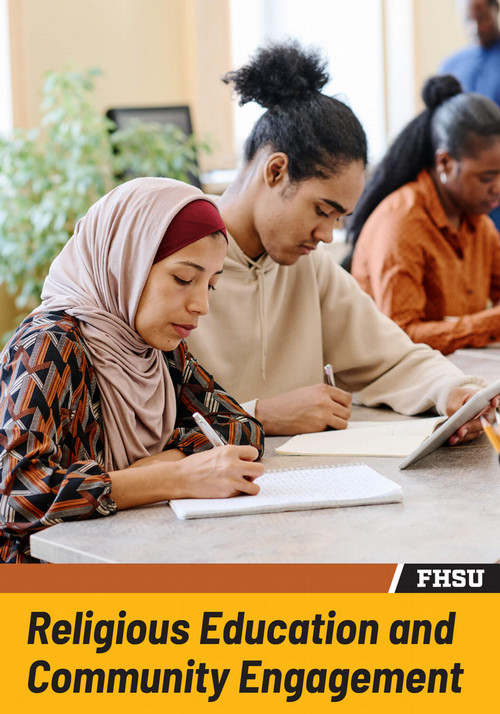
Bachelor of Arts in Religious Education and Community Engagement
Hours: 120 On-Campus Online
The Bachelor of Arts in Religious Education and Community Engagement at Fort Hays State University prepares students for meaningful work that connects faith, education, and community service. provides a strong academic foundation in religious traditions, Christian doctrine, world religions, and the New Testament, while integrating applied learning in leadership and nonprofit engagement.
Through an interdisciplinary curriculum that includes coursework in religious studies, philosophy, sociology, leadership, and marketing, students develop critical thinking, ethical insight, and practical skills needed to serve in churches, faith-based organizations, and community nonprofits. The program supports professional preparation without requiring ordination, allowing graduates to pursue a variety of community-centered careers.
Courses are offered online and on campus, providing students with flexibility to complete the degree in a way that aligns with their academic and professional goals.
Who is this program for?
This program serves undergraduate students seeking to combine the academic study of religion with practical skills in community engagement. It is especially well-suited for:
- Aspiring religious educators
- Individuals pursuing nonprofit careers
- Learners seeking leadership preparation
- Students planning graduate or seminary study
- Community-focused professionals
The Best Value in Higher Education Anywhere
Fort Hays State University prides itself on quality education at an affordable price. Students in this program can expect to pay approximately $3,237.60* (on-campus) or $4,134.75* (online) per semester.
*Estimated cost based on 15 credit hours at the Undergrad resident/regional tuition rate ($215.84/credit hour) for on-campus courses, or the FHSU Online Undergrad tuition rate (275.65/credit hour) for online courses. Actual price may vary depending on course load and location. Tuition and Fees are subject to change as they are approved by the Kansas Board of Regents each year.
The curriculum provides a strong foundation in religious studies, leadership, and community engagement. Core courses and electives, along with applied projects, let students tailor their studies, develop practical skills, and align learning with career or graduate goals. This flexible, experience-based approach prepares graduates for professional success and advanced academic opportunities.
PHIL 170: World Religions
This course is a survey of major world religions, Hinduism, Buddhism, Judaism, Christianity, and Islam, examining their histories, core beliefs, and practices. The course also explores contemporary ethical issues and philosophical questions about religion, morality, and the good life.
LDRS 302: Introduction to Leadership Behavior
In this course, students develop foundational leadership skills through practical experience in collaboration, communication, adaptive leadership, conflict resolution, and creative thinking. Students design and apply change strategies for organizations or communities while strengthening personal and organizational leadership abilities.
SOC 680: Nonprofit Organizations
This course examines the management and operations of nonprofit organizations, highlighting similarities and differences with for-profit enterprises. Students explore nonprofit formation, including mission development and tax-exempt status, as well as key areas such as leadership, human resources, strategic planning, financial management, and marketing in mission-driven organizations.
Discover the full Bachelor of Arts in Religious Education and Community Engagement course listing by visiting the Academic Catalog.
Graduates are prepared for careers that combine knowledge of religious education, leadership, and nonprofit management. The program’s comprehensive curriculum and applied learning experiences ensure students are ready to meet the demands of service-oriented professions. Some potential career paths include:
Religious Education Director
Religious education directors lead educational programming within churches and faith-based organizations by developing curricula, supervising volunteers, and providing instructional guidance. Community engagement and teaching are central to this role.
Nonprofit Program Coordinator
Nonprofit program coordinators manage program development, grant writing, and organizational operations. They emphasize collaboration with community partners and stakeholders.
Community Outreach Specialist
Community outreach specialists support public engagement initiatives through education, communication, and leadership activities. Outreach efforts strengthen connections between organizations and the communities they serve.
Church Administrator
Church administrators oversee operations within religious organizations, including financial coordination, organizational leadership, and internal communication. They combine administrative and strategic responsibilities.
Graduate Study Preparation
Graduate study preparation provides a strong academic foundation for entry into master’s degree programs, seminary, or graduate study in counseling, theology, education, or related fields.
Ready for the next step?
Our faculty would be excited to talk to you about how our department programs can help you explore your interests and prepare you for a variety of rewarding careers.
Related Programs
Fort Hays State University offers several related programs that complement the B.A. in Religious Education and Community Engagement, allowing students to expand their knowledge and develop interdisciplinary skills. These programs provide opportunities to explore topics that strengthen professional competencies and broaden career pathways. Students are encouraged to pursue academic exploration beyond their major to support personal and professional growth.
Students interested in forensic science may also consider related programs at Fort Hays State University that offer complementary skills and knowledge. Each program provides distinct pathways to criminal justice, biology, and forensic analysis careers, equipping students with versatile skills applicable across various fields:
- B.A. in History
- B.A./B.S. in Sociology
- B.A./B.S. in Political Science
- B.A./B.S. in Organizational Leadership
This program typically requires 120 credit hours. Time to complete may vary based on enrollment, transfer credits, and course availability. Our academic advisors help students stay on track for timely completion.
The program offers flexible scheduling with online and on-campus courses. Students can enroll in fall, spring, and summer semesters to balance coursework with professional or personal responsibilities.
Yes. The program includes a required internship near the end, placing students in a church or nonprofit organization for supervised, hands-on experience that applies classroom learning to real-world settings.
The religious education curriculum incorporates the study of world religions. It emphasizes comparative academic analysis of spiritual traditions to support a broader understanding of religion in public life. The education revolves around academic research, not doctrinal teaching.
Assigned academic advisors provide guidance related to coursework, degree planning, and graduation requirements. Applicants can also direct program-specific questions to the program director.
Information about the Department of History and Philosophy
The Department of History and Philosophy at FHSU offers a comprehensive educational experience that develops students' critical thinking, analytical, and communication skills.
The History Programs provide in-depth coursework exploring a wide range of historical periods and cultures, preparing students for careers in education, research, public history, and related fields. The Philosophy Programs challenge students to examine fundamental questions about existence, knowledge, ethics, and values, fostering strong problem-solving skills and a thoughtful, reflective approach to life.
Together, these programs deliver a well-rounded education that combines historical understanding with philosophical inquiry. Graduates are equipped with the intellectual tools to succeed in diverse career paths and to contribute thoughtfully and effectively to society.
While earning a degree remains the primary focus, college life offers much more than classroom learning. Students are encouraged to participate in extracurricular activities that foster leadership skills, deepen their understanding of their chosen careers, and provide opportunities to make a positive impact in their communities.
- Phi Alpha Theta & History Club: This student organization provides a dynamic environment for engaging in intellectual discussions, film analyses, and activities centered on specific historical themes. The club fosters a collaborative and enriching learning experience for students passionate about history.
- Philosophy Club: This club offers students the opportunity to engage in thoughtful philosophical discussions that span multiple disciplines and address real-world issues, fostering meaningful dialogue between peers and faculty.
- Victor E. History Podcast: Hosted by faculty member Hollie Marquess, this podcast showcases research conducted by students, faculty, and alumni within the History Programs, highlighting diverse historical topics and scholarship.
- Bachelor's
- On-Campus
- Online