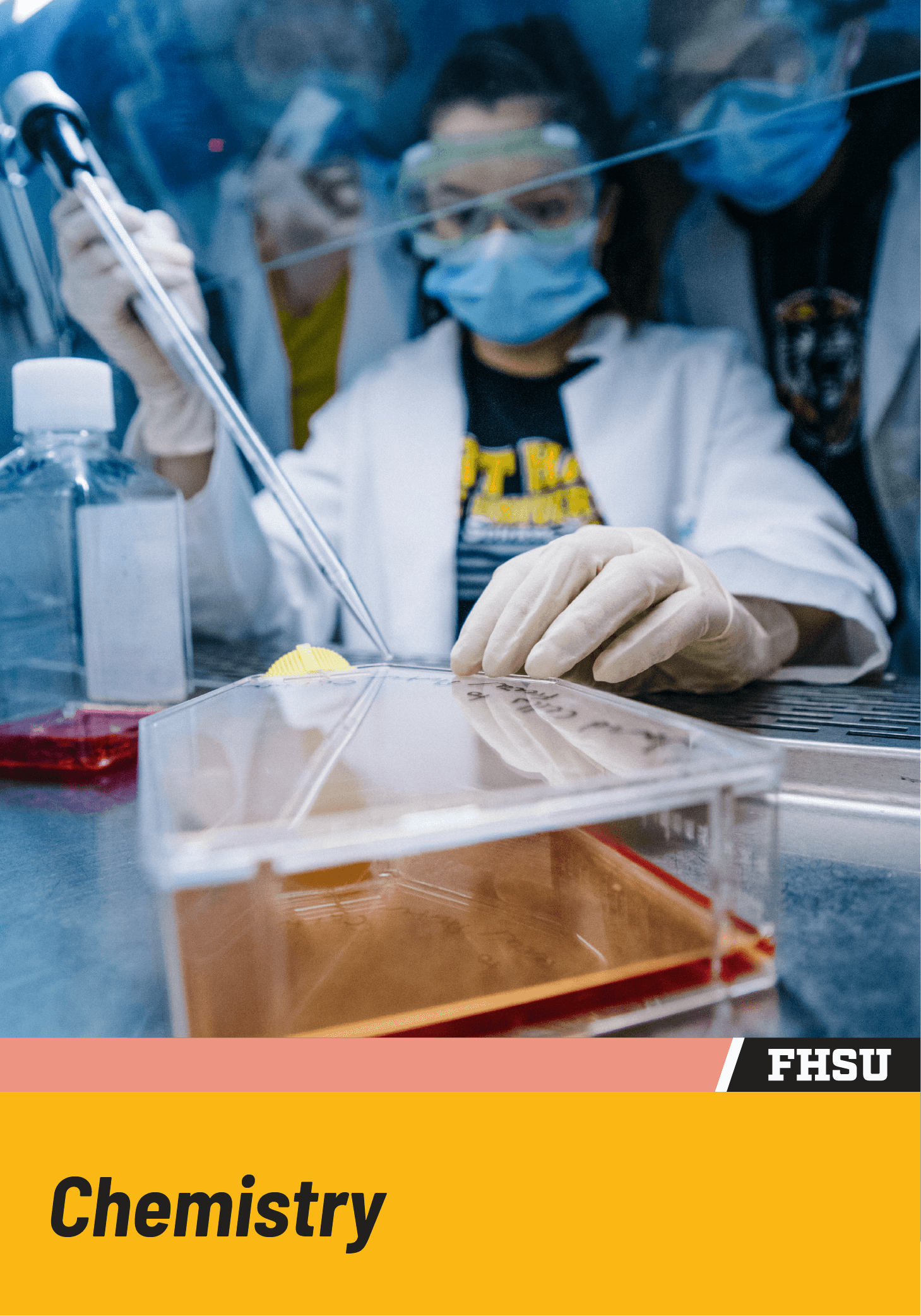
Minor in Chemistry
Hours: 20 On-Campus
The Minor in Chemistry at Fort Hays State University provides students with a strong foundation in chemical principles and laboratory techniques. It complements majors such as biology, environmental science, health sciences, and agricultural science, equipping students with essential knowledge and practical skills for success in scientific and industrial careers. The curriculum encompasses core areas, including organic, inorganic, physical, and analytical chemistry, with a focus on hands-on laboratory experiences, critical thinking, and problem-solving. Students benefit from expert faculty guidance and state-of-the-art facilities that support learning and skill development.
Who is this program for?
This minor is well-suited for students across a range of majors who wish to enhance their scientific knowledge and skills. It is particularly valuable for those pursuing careers that require a strong foundation in chemistry or for students preparing for advanced study in related fields.
- Biology
- Environmental Science
- Health Science
- Pre-Med
- Materials Science and Engineering
- Agriculture and Nutrition
- Any major requiring a solid foundation in chemistry, agriculture, and nutrition
The Best Value in Higher Education Anywhere
Fort Hays State University prides itself on quality education at an affordable price. Students in this program can expect to pay approximately $3,237.60* (on-campus) per semester.
*Estimated cost based on 15 credit hours at the Undergrad resident/regional tuition rate ($215.84/credit hour) for on-campus courses. Actual price may vary depending on course load and location. Tuition and Fees are subject to change as they are approved by the Kansas Board of Regents each year.
The core curriculum provides a strong foundation in chemical principles, combining required courses in general, organic, and analytical chemistry with extensive laboratory experience to develop practical skills. Electives allow students to explore specialized areas such as biochemistry, environmental chemistry, and physical chemistry. Together, the core and elective courses offer a well-rounded education, equipping students with the knowledge and skills needed for diverse scientific careers or advanced study.
CHEM 120/120L: University Chemistry I/Laboratory
University Chemistry I is the first course in a two-semester sequence that serves as an introduction to chemistry for science majors and students pursuing pre-engineering, pre-veterinary, pre-pharmacy, and pre-medical studies.
CHEM 122/122L: University Chemistry II/Laboratory
This course is a continuation of CHEM 120, further exploring the principles of chemistry. Students will participate in three recitation sessions each week, focusing on hands-on problem-solving and in-depth discussions along with a laboratory component.
CHEM 352/352L: Environmental Chemistry/Laboratory
This course applies chemical principles to natural systems, exploring key processes in the atmosphere, hydrosphere, biosphere, and lithosphere. It examines pollutant sources, sinks, impacts, and control measures. Laboratory experiments utilize wet and instrumental methods of environmental analysis, emphasizing established protocols, and include a problem-solving session to reinforce key concepts.
Discover the full Minor in Chemistry course listing by visiting the Academic Catalog.
Graduates have access to a wide range of career opportunities. With a strong foundation in chemical principles and practical skills, they are well-prepared for diverse professional roles. Potential career paths include:
Laboratory Technician
Laboratory technicians support research labs, industry, and healthcare by conducting experiments, analyzing results, and maintaining equipment to ensure accurate and efficient operations.
Quality Control Analyst
Quality control analysts conduct chemical tests and develop protocols to ensure that products meet safety and quality standards in various industries, including pharmaceuticals, food production, and manufacturing.
Environmental Scientist
Environmental scientists utilize chemistry to address pollution, waste management, and sustainability, collaborating with government agencies, non-profit organizations, and the private sector to develop innovative environmental solutions.
Pharmaceutical Sales Representative
Pharmaceutical sales representatives use scientific knowledge to communicate product benefits and support healthcare professionals in making informed decisions. They build client relationships, identify market opportunities, and provide guidance on product applications to ensure optimal patient care and outcomes.
Ready for the next step?
Our faculty would be excited to talk to you about how our department programs can help you explore your interests and prepare you for a variety of rewarding careers.
Related Programs
For students looking to expand their expertise beyond the Minor in Chemistry, Fort Hays State University offers a variety of related programs that complement and enhance their academic experience. These programs provide valuable opportunities for interdisciplinary learning and professional development.
- B.A./B.S. in Chemistry
- Minor in Biology
- B.A. in Environmental Geosciences
- B.S. in Health and Human Performance
The Minor in Chemistry is designed to be flexible and can complement various major programs. It allows students to explore their interests in chemistry without committing to a full degree.
Career options include roles in laboratory research, quality control, environmental science, pharmaceutical sales, and more. The minor provides a solid foundation that enhances employability in diverse fields.
Yes, the Minor in Chemistry is designed to complement majors in biology and health science. It provides interdisciplinary knowledge that is beneficial for various career paths.
Yes, students can access undergraduate research projects and participate in professional conferences. These opportunities provide practical experience and enhance their academic profiles.
Students will engage in laboratory courses, research projects, and internships that provide practical, real-world experience in chemistry. These activities are crucial for developing technical skills and professional readiness.
Information about the Department of Chemistry
The Department of Chemistry at FHSU offers a comprehensive education designed to equip students with advanced knowledge of chemistry and strong research skills. Supported by experienced faculty, students develop technical expertise and problem-solving abilities essential for success in the workforce or in graduate and professional schools.
Students engage in extensive hands-on learning and research using state-of-the-art equipment, preparing them for a wide range of careers in scientific and healthcare fields. Whether pursuing careers in teaching, research, or professional programs such as medical or dental schools, the department offers in-depth undergraduate and pre-professional programs tailored to individual goals.
Graduates of the chemistry programs are highly sought after across a wide range of chemistry-related professions. With a solid academic foundation and dedicated faculty support, students are well-prepared to embark on successful careers upon completing the programs.
While earning a degree remains the primary focus, college life offers much more than classroom learning. Students are encouraged to participate in extracurricular activities that foster leadership skills, deepen their understanding of their chosen careers, and provide opportunities to make a positive impact in their communities.
- Chemistry/Pre-Professional Club: This club fosters professional development, academic excellence, practical education, and community service within the sciences. Its activities include popular Magic Shows for local schools, tutoring services, and scholarship opportunities for active members. For more information, students may contact Dr. Arvin Cruz.
- AMSA/Premedical Club: This organization supports pre-medical, pre-dental, and pre-optometry students by helping them prepare for entrance exams and stay focused on their academic and professional goals. The club offers valuable opportunities such as clinic visits, field trips to professional schools, and networking events with healthcare professionals. For more information, students are encouraged to contact Dr. James Balthazor.
- Minor
- Bachelor's
- Master's
- On-Campus