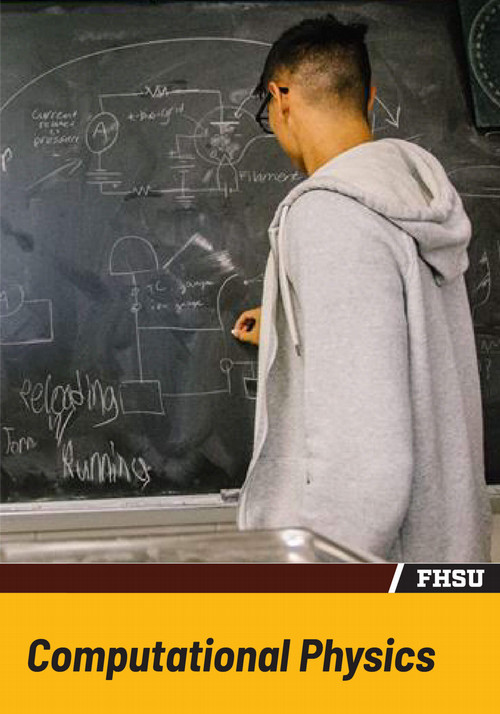
Certificate in Computational Physics
Hours: 15 On-Campus
The Certificate in Computational Physics at Fort Hays State University is a hands-on credential designed to build advanced computational skills for tackling real-world challenges in physics. Offered on campus, the certificate includes five applied courses that immerse students in modern computational tools, programming, and techniques.
The curriculum emphasizes practical software development and applications in scientific and engineering contexts, including experience with computing environments beyond standard systems, such as Windows and macOS. Students also learn to create professional technical reports and documentation, ensuring their computational work is communicated clearly and effectively.
Who is this program for?
The certificate is designed for students, professionals, and STEM graduates who seek to strengthen their computational skills for real-world problem-solving. It supports career growth in data science, engineering, research, and other fields that rely on modeling, simulation, or analysis, while also providing a strong foundation for those transitioning into high-demand technical careers.
- Students looking to deepen their computational skills
- Individuals seeking to enhance their technical expertise using advanced computational tools
- Those working in academic or industry research looking to strengthen their computational capabilities
- Professionals from other fields looking to transition into high-demand industries like data science, computational modeling, or software development in scientific domains
The Best Value in Higher Education Anywhere
Fort Hays State University prides itself on quality education at an affordable price. Students in this program can expect to pay approximately $3,237.60* (on-campus) per semester.
*Estimated cost based on 15 credit hours at the Undergrad resident/regional tuition rate ($215.84/credit hour) for on-campus courses. Actual price may vary depending on course load and location. Tuition and Fees are subject to change as they are approved by the Kansas Board of Regents each year.
The curriculum equips students with advanced computational skills to tackle real-world physics challenges. Five applied courses focus on software development, data analysis, and modern computing platforms, providing hands-on experience to solve complex issues in physics, engineering, and data science.
PHYS 211/211L: Engineering Physics I/Laboratory
This course is a calculus-based study of mechanics, wave motion, and thermodynamics for science and engineering majors, along with a laboratory component.
PHYS 312: Scientific Computing and Productivity
This course is an introduction to the Linux operating system, focusing on tools for data analysis, plotting, scientific writing, and running simulations across various scientific fields.
PHYS 333: Introduction to Computational Physics
This course introduces problem-solving in science and engineering using freely available software, with a focus on leveraging software libraries to address challenges beyond analytical methods. It also presents data visualization and computer graphics.
Discover the full Certificate in Computational Physics course listing by visiting the Academic Catalog.
Students who complete the Certificate in Computational Physics are well-prepared for a variety of career paths in science, engineering, and technology. With hands-on experience in modern computational tools and techniques, they are equipped to make meaningful contributions in rapidly evolving research and industry environments.
Research Assistant
Research assistants support scientific research through computational data analysis, modeling, and problem-solving. They typically work in laboratories or academic settings, assisting with data collection, software development, and simulations in fields such as physics, materials science, and engineering.
Biomedical Engineer
Biomedical engineers apply computational models to design and improve medical devices, prosthetics, and diagnostic tools. They collaborate with healthcare professionals to address challenges in physiology and biomechanics, advancing innovations like imaging systems and personalized treatments.
Laboratory Manager
Laboratory managers oversee research lab operations by managing projects, coordinating data collection, and ensuring the effective use of computational tools. They supervise staff, maintain equipment, enforce safety protocols, and support data analysis to keep labs aligned with current technology and research standards.
Nontechnical Positions in Publishing and Sales
Students may pursue roles in publishing, where they write or edit scientific content for broader audiences, or in sales, where their technical knowledge supports the promotion of scientific software, tools, and lab equipment to clients in research, academia, and industry.
Ready for the next step?
Our faculty would be excited to talk to you about how our department programs can help you explore your interests and prepare you for a variety of rewarding careers.
Related Programs
Fort Hays State University offers related programs that complement the Certificate in Computational Physics, enabling students to further specialize in areas such as computational modeling, software development, and data analysis. These programs allow students to expand their expertise and enhance their career prospects in science and technology.
- B.A./B.S. in Physics
- B.S. in Computer Science
- M.S. in Computer Science
- Certificate in Applied Data Analysis
Participants will receive comprehensive support from faculty members, have access to online resources, and have opportunities for peer collaboration throughout the program.
A Certificate in Computational Physics prepares students for careers in research, engineering, and both technical and nontechnical roles. Potential paths include research assistant, biomedical engineer, laboratory manager, or positions in publishing and sales that benefit from computational expertise.
To apply for the Certificate in Computational Physics, complete the standard admission process at Fort Hays State University, ensuring that you fulfill the academic prerequisites and submit all required materials.
Information about the Department of Physics
The Department of Physics at FHSU offers comprehensive programs that encourage students to explore the fundamental aspects of space, time, matter, and energy. The curriculum provides a strong foundation in physics, enhanced by hands-on learning in advanced fields such as robotics, laser bio-effects, atomic physics, and materials science.
With guidance from dedicated faculty, students engage in research early in their academic journey, benefiting from the resources of a state university along with the personalized support of a close-knit academic community. Graduates are well-prepared for a variety of scientific careers or for continued study in competitive graduate programs.
While earning a degree remains the primary focus, college life offers much more than classroom learning. Students are encouraged to participate in extracurricular activities that foster leadership skills, deepen their understanding of their chosen careers, and provide opportunities to make a positive impact in their communities.
- FHSU Physics and Engineering Club: This student organization combines the departmental club with national chapters of the Society of Physics Students and Sigma Pi Sigma. It hosts a variety of events, including the Science Quiz Bowl and the Physics Roadshow, promoting engagement, collaboration, and outreach within the physics and engineering communities.
- FHSU Astronomy Club: The FHSU Astronomy Club offers opportunities for students and the public to explore the night sky. The club hosts public observation events and manages the Tomanek Hall Observation Deck and the Albertson Hall Astronomy Tower, fostering interest in astronomy through hands-on experiences and community engagement.
- Certificate
- On-Campus