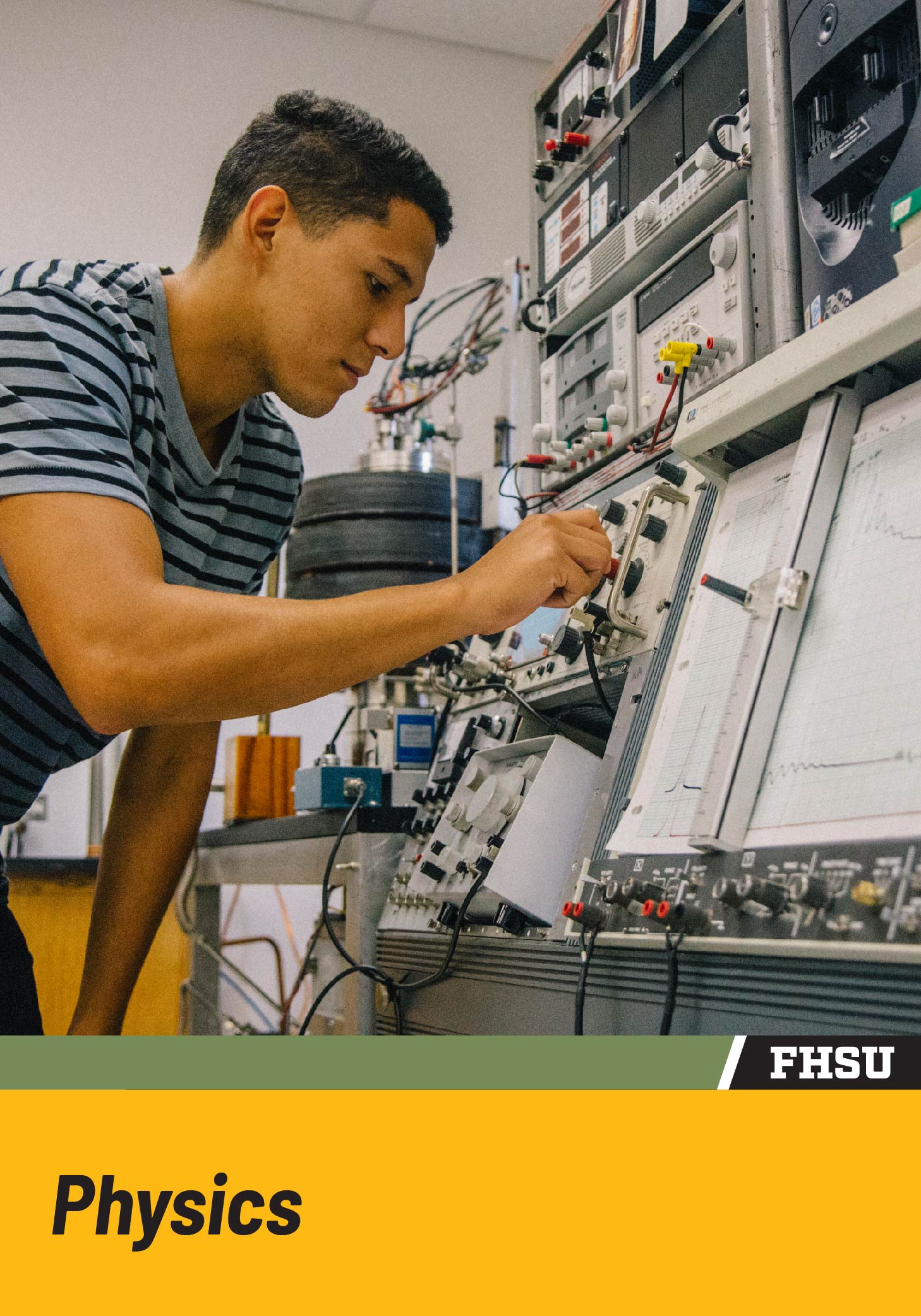
Bachelor of Arts or Bachelor of Science in Physics
Hours: 120 On-Campus
The Bachelor of Arts and Bachelor of Science in Physics programs at Fort Hays State University provide a thorough understanding of the fundamental principles of physics. The curriculum provides a strong foundation in theoretical and applied physics, beginning with introductory courses such as physical science and progressing to advanced topics like quantum mechanics.
Beyond core scientific training, the programs foster critical thinking by exploring the logic and philosophy behind physical theories. Students also gain experience in high-level research, theoretical analysis, and hands-on experimentation, equipping them for diverse scientific and technical careers or further study in physics.
Who is this program for?
These programs are ideal for students passionate about physics and seeking a well-rounded education that prepares them for diverse career paths. Flexible and tailored to individual goals and interests, the programs are especially well-suited for:
- Aspiring physicists
- Individuals aiming for careers in aerospace, automotive, or renewable energy sectors
- Future leaders in technology and innovation
- Those seeking a solid foundation for advanced studies or research
The Best Value in Higher Education Anywhere
Fort Hays State University prides itself on quality education at an affordable price. Students in this program can expect to pay approximately $3,237.60* (on-campus) per semester.
*Estimated cost based on 15 credit hours at the Undergrad resident/regional tuition rate ($215.84/credit hour) for on-campus courses. Actual price may vary depending on course load and location. Tuition and Fees are subject to change as they are approved by the Kansas Board of Regents each year.
The curriculum offers in-depth coverage of core subjects, including mechanics, electromagnetism, thermodynamics, optics, and quantum mechanics. Students also have an opportunity to explore advanced topics in specialized areas, allowing them to tailor their studies to their personal interests and career goals.
PHYS 211/211L: Engineering Physics I/Laboratory
A calculus-based study of mechanics, wave motion, and thermodynamics for majors in science and engineering, along with a laboratory component.
PHYS 212/212L: Engineering Physics II/Laboratory
A calculus-based study of electricity, magnetism, optics, and laboratory components.
PHYS 313: Modern Physics
A survey of atomic physics, relativity, and an introduction to quantum theory.
Discover the full Bachelor of Arts in Physics or Bachelor of Science in Physics course listings by visiting the Academic Catalog.
Graduates develop a versatile skill set that prepares them for a wide range of careers in industry, government, and beyond. Some of the rewarding career paths available include:
Research Scientist
Research scientists research in fields such as materials science, optics, or astronomy, analyzing data, developing innovative technologies, and contributing to advancements in scientific knowledge.
Medical Physicist
Medical physicists apply principles of physics in healthcare environments, utilizing radiation for diagnostic imaging and treatments such as cancer therapy. This career path typically involves specialized coursework in radiation physics and medical imaging.
Data Analyst
Data analysts apply advanced analytical and problem-solving skills to interpret complex datasets across various industries, including finance, healthcare, and technology. Their expertise enables them to identify trends and patterns, supporting data-driven decision-making and strategic planning.
Engineer
Engineers build on a solid foundation of physics by integrating core engineering principles and design skills to pursue careers in mechanical, electrical, or aerospace engineering.
Ready for the next step?
Our faculty would be excited to talk to you about how our department programs can help you explore your interests and prepare you for a variety of rewarding careers.
Related Programs
Fort Hays State University offers a variety of related programs within the Department of Physics and across other disciplines that complement the B.A./B.S. in Physics, allowing students to tailor their education to their individual interests and career goals.
- B.S. in Physics (Pre-Engineering) (2+2 Program)
- Certificate in Computational Physics
- Minor in Physics
Fort Hays State University offers several scholarships, including the Regents Scholarship for first-time freshmen, which covers full tuition, fees, room, and board, based on strong academic performance. Additional awards, such as Tier 1 and Tier 2 Scholarships, support first-year, KAMS/AMS, and transfer students, prioritizing those with high academic achievement and leadership potential.
The B.A./B.S. in Physics programs place strong emphasis on undergraduate research. All physics students are required to complete a research project, providing hands-on experience that applies classroom knowledge to real-world challenges while developing essential research skills, analytical thinking, and critical problem-solving abilities.
The programs cover essential areas, including mechanics, electromagnetism, thermodynamics, optics, and quantum mechanics, ranging from basic to advanced levels. By combining theoretical study with hands-on experimentation, the curriculum prepares students to address a wide range of challenges in the field.
Students pursuing a B.A. in Physics are required to complete ten credit hours of instruction in a language other than English. This requirement is designed to provide students with a broader cultural and linguistic perspective.
In contrast, the B.S. in Physics does not mandate foreign language study, allowing students to focus more intensively on technical and scientific coursework within their field of study. Despite this key difference, both degree programs share similar overall requirements in terms of total credit hours and core coursework. This equivalence ensures that students receive a comprehensive education within their major field of study, regardless of the chosen degree path.
Earning a B.A. or B.S. in Physics opens doors to a variety of careers, including research scientist, medical physicist, and data analyst. With a strong foundation in core physics principles, a focus on computational skills, and extensive research and hands-on learning experiences, the programs also prepare graduates for advanced studies in physics, engineering, or education.
Information about the Department of Physics
The Department of Physics at FHSU offers comprehensive programs that encourage students to explore the fundamental aspects of space, time, matter, and energy. The curriculum provides a strong foundation in physics, enhanced by hands-on learning in advanced fields such as robotics, laser bio-effects, atomic physics, and materials science.
With guidance from dedicated faculty, students engage in research early in their academic journey, benefiting from the resources of a state university along with the personalized support of a close-knit academic community. Graduates are well-prepared for a variety of scientific careers or for continued study in competitive graduate programs.
While earning a degree remains the primary focus, college life offers much more than classroom learning. Students are encouraged to participate in extracurricular activities that foster leadership skills, deepen their understanding of their chosen careers, and provide opportunities to make a positive impact in their communities.
- FHSU Physics and Engineering Club: This student organization combines the departmental club with national chapters of the Society of Physics Students and Sigma Pi Sigma. It hosts a variety of events, including the Science Quiz Bowl and the Physics Roadshow, promoting engagement, collaboration, and outreach within the physics and engineering communities.
- FHSU Astronomy Club: The FHSU Astronomy Club offers opportunities for students and the public to explore the night sky. The club hosts public observation events and manages the Tomanek Hall Observation Deck and the Albertson Hall Astronomy Tower, fostering interest in astronomy through hands-on experiences and community engagement.
- Minor
- Bachelor's
- On-Campus