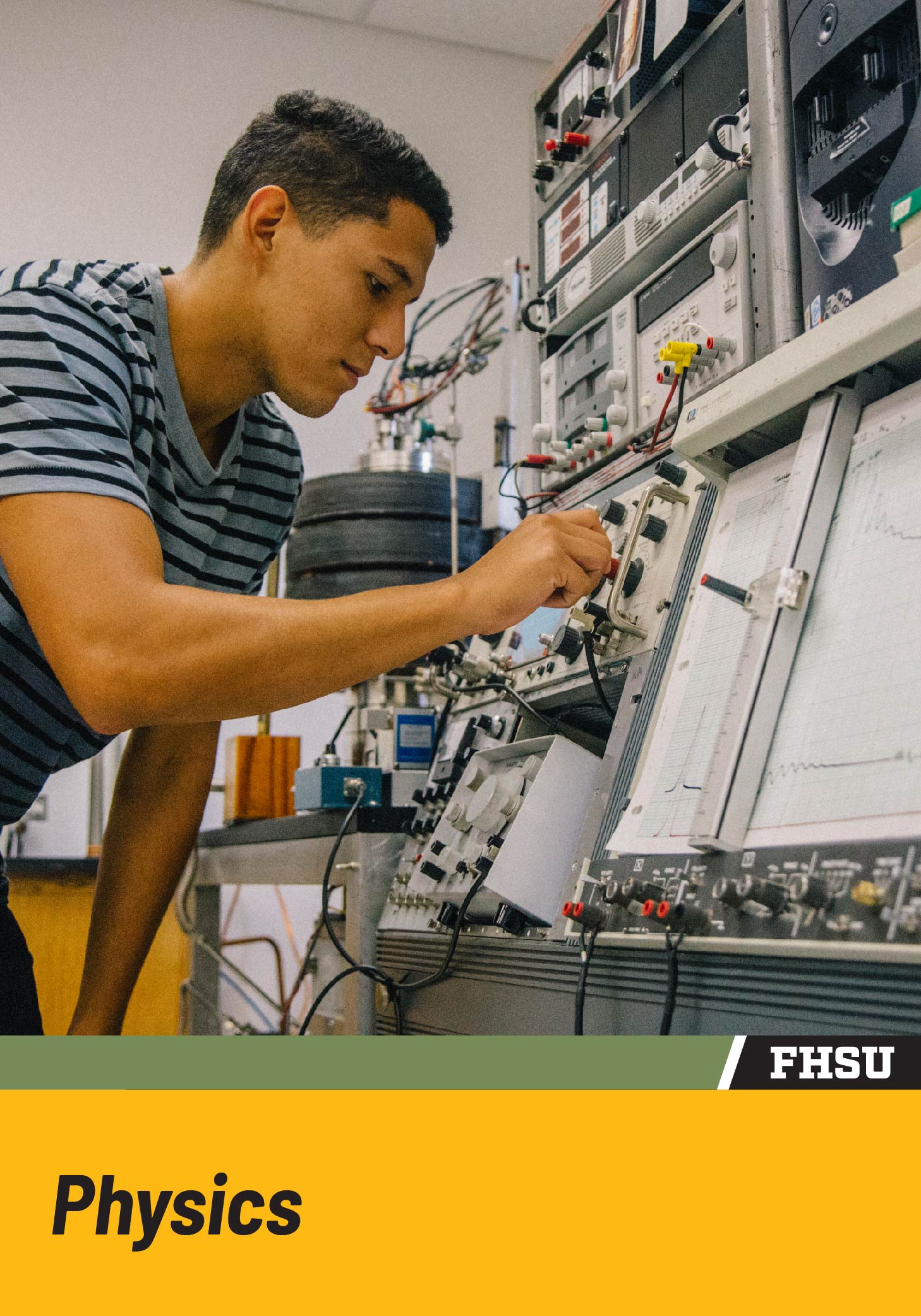
Minor in Physics
Hours: 20 On-Campus
The Minor in Physics at Fort Hays State University allows students to deepen their understanding of fundamental physical principles that underpin a wide range of scientific and technical fields. Through courses in Newtonian mechanics, electromagnetism, thermodynamics, and modern physics, students gain strong analytical and problem-solving skills highly valued in today’s job market.
This program is particularly advantageous for students majoring in science, mathematics, computer science, or engineering, as it complements their primary field of study while providing practical, hands-on experience in laboratory settings.
Who is this program for?
This minor is ideal for students passionate about science who wish to strengthen their major with a solid foundation in physics. It is especially well-suited for:
- Student majoring in science, mathematics, computer science, or engineering
- Individuals seeking to improve their problem-solving and analytical skills
- Those interested in pursuing careers in technology or research
- Students aiming to broaden their scientific knowledge
- Individuals planning to attend graduate school in a STEM field
The Best Value in Higher Education Anywhere
Fort Hays State University prides itself on quality education at an affordable price. Students in this program can expect to pay approximately $3,237.60* (on-campus) per semester.
*Estimated cost based on 15 credit hours at the Undergrad resident/regional tuition rate ($215.84/credit hour) for on-campus courses. Actual price may vary depending on course load and location. Tuition and Fees are subject to change as they are approved by the Kansas Board of Regents each year.
The core curriculum covers Newtonian mechanics, electromagnetism, thermodynamics, and modern physics, providing a solid foundation in fundamental principles and their applications. Laboratory courses offer hands-on experience with experiments, instrumentation, and data analysis, reinforcing theoretical knowledge. Electives allow students to tailor their studies to individual interests and career goals. Through this combination of coursework and experiential learning, the minor prepares graduates with the knowledge and skills needed for diverse scientific and technical careers.
PHYS 100: Introduction to Physics and Engineering
The course will introduce students to the physics and engineering disciplines, developing their problem-solving, experimental design, and technical writing skills through individual and group activities. Career fields and pathways in physics and engineering will also be explored.
PHYS 211/211L: Engineering Physics I/Laboratory
A calculus-based study of mechanics, wave motion, and thermodynamics for majors in science and engineering, along with a laboratory component.
PHYS 212/212L: Engineering Physics II/Laboratory
A calculus-based study of electricity, magnetism, and optics, along with a laboratory component.
Discover the full Minor in Physics course listing by visiting the Academic Catalog.
Graduates are well-prepared for a wide range of career opportunities, thanks to their strong foundation in physics and well-honed analytical skills. This versatile background opens doors across scientific, technical, and interdisciplinary fields. Potential career paths include:
Research Assistant
Research assistants support scientific investigations by conducting experiments, collecting and analyzing data, and assisting with ongoing research projects in academic, government, or industry settings. This role requires strong analytical and problem-solving abilities.
Lab Technician
Lab technicians are responsible for maintaining laboratory equipment, preparing experiments, and supporting scientists in research and development activities.
Technical Analyst
Technical analysts apply analytical and problem-solving skills to address technical challenges and optimize processes in engineering, manufacturing, and technology sectors.
Engineering Assistant
Engineering assistants support engineers in the design, testing, and implementation of technical solutions across various engineering fields.
Science Educator
Science educators teach physics concepts at the secondary school level or develop educational materials for academic institutions. A strong understanding of physics principles, combined with practical communication skills, enables them to inspire and educate the next generation of scientists and engineers.
The admission requirements for the Minor in Physics are designed to identify students who are academically prepared and committed to their studies. Prospective students must first meet the general admission criteria, which include:
Academic Achievement
Applicants should have a strong academic record, particularly in mathematics and science courses. A minimum GPA of 2.5 or higher is typically required to demonstrate readiness for the program’s academic rigor and ensure students have the foundational knowledge needed to succeed in physics coursework.
Personal Statement
Applicants must submit a personal statement outlining their interest in physics, academic and career goals, and how the minor will support their objectives. This statement provides insight into the applicant’s motivation and commitment to the field.
Letters of Recommendation
Applicants must provide letters of recommendation from teachers or mentors who can attest to their academic abilities and potential for success. These letters should highlight the applicant’s strengths, work ethic, and suitability for the minor.
Application Fee
Applicants must submit any required fees to complete the application process. This ensures that the application is processed and reviewed promptly.
Ready for the next step?
Our faculty would be excited to talk to you about how our department programs can help you explore your interests and prepare you for a variety of rewarding careers.
Related Programs
Students interested in the Minor in Physics may also consider related programs that complement their academic and career goals. Related offerings at Fort Hays State University include:
- B.A./B.S. in Physics
- B.A./B.S. in Mathematics (Industrial/Academic)
- B.S. in Computer Science
- B.S in Physics (Pre-Engineering) (2+2 Program)
- B.A. in Environmental Geosciences
The minor includes a sequence of core courses such as Newtonian mechanics, electromagnetism, thermodynamics, and modern physics. Additionally, laboratory courses are required to provide students with practical, hands-on experience.
A Minor in Physics complements a major by providing a strong foundation in fundamental principles, strengthening problem-solving abilities, and offering practical laboratory experience. These skills and knowledge are valuable and applicable across a wide range of fields.
Yes, this minor includes several laboratory courses that provide students with practical experience in experimental techniques and data analysis. These labs also serve to reinforce the theoretical concepts covered in the core curriculum.
Graduates can pursue careers in research, engineering, technology, education, and various scientific fields. Their strong analytical and problem-solving skills provide a valuable foundation for success in these areas.
To apply for the Minor in Physics, follow the standard admission process at Fort Hays State University, ensuring you meet the academic requirements and submit any necessary documentation, such as transcripts and a personal statement.
Information about the Department of Physics
The Department of Physics at FHSU offers comprehensive programs that encourage students to explore the fundamental aspects of space, time, matter, and energy. The curriculum provides a strong foundation in physics, enhanced by hands-on learning in advanced fields such as robotics, laser bio-effects, atomic physics, and materials science.
With guidance from dedicated faculty, students engage in research early in their academic journey, benefiting from the resources of a state university along with the personalized support of a close-knit academic community. Graduates are well-prepared for a variety of scientific careers or for continued study in competitive graduate programs.
While earning a degree remains the primary focus, college life offers much more than classroom learning. Students are encouraged to participate in extracurricular activities that foster leadership skills, deepen their understanding of their chosen careers, and provide opportunities to make a positive impact in their communities.
- FHSU Physics and Engineering Club: This student organization combines the departmental club with national chapters of the Society of Physics Students and Sigma Pi Sigma. It hosts a variety of events, including the Science Quiz Bowl and the Physics Roadshow, promoting engagement, collaboration, and outreach within the physics and engineering communities.
- FHSU Astronomy Club: The FHSU Astronomy Club offers opportunities for students and the public to explore the night sky. The club hosts public observation events and manages the Tomanek Hall Observation Deck and the Albertson Hall Astronomy Tower, fostering interest in astronomy through hands-on experiences and community engagement.
- Minor
- Bachelor's
- On-Campus