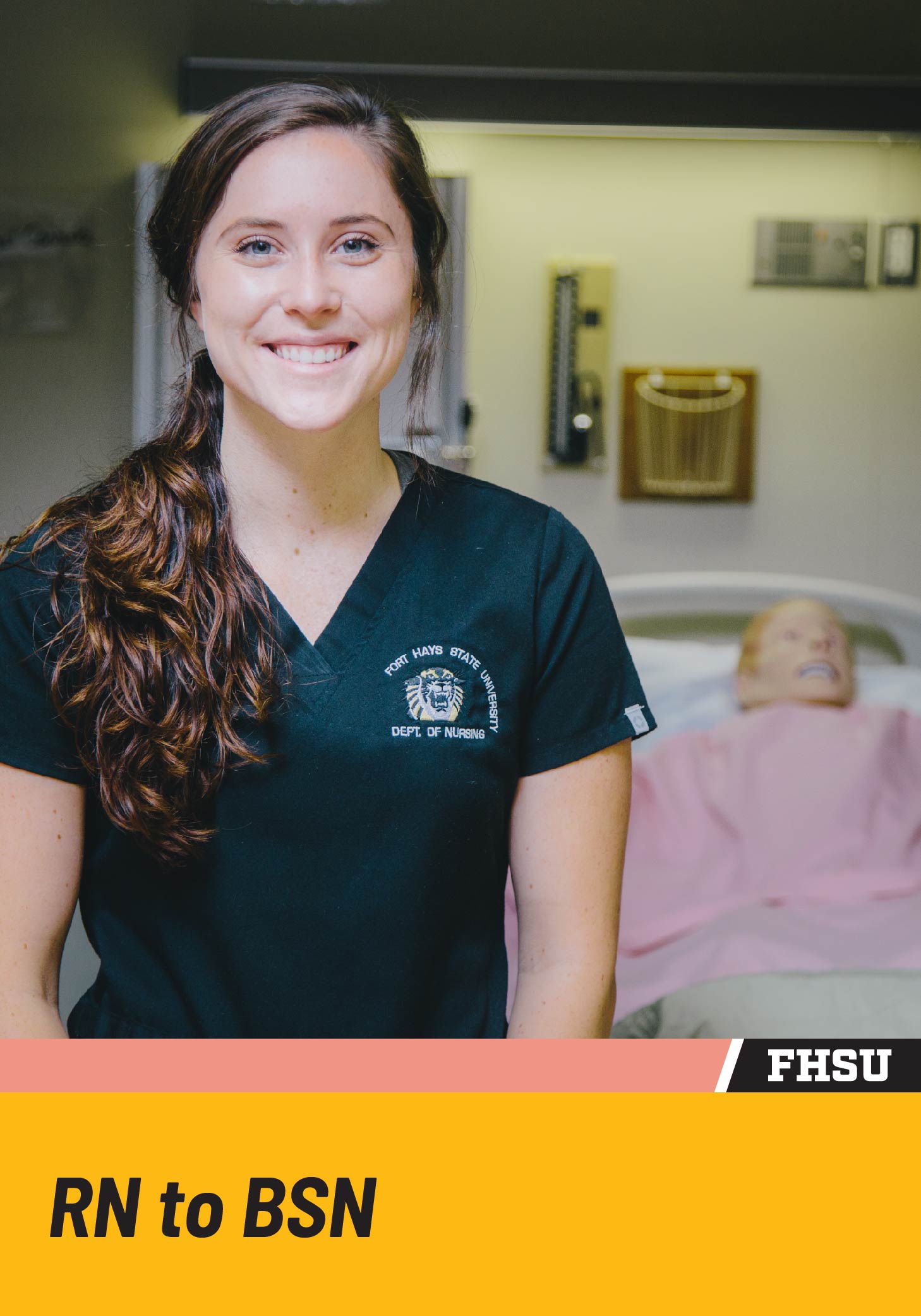
RN to BSN Program
Hours: 120 Online
The online RN to BSN program at Fort Hays State University is specifically designed for registered nurses seeking to advance their education and career. Structured to accommodate the demands of working professionals, the program offers the flexibility needed to balance academic responsibilities and professional commitments. Students must complete 120 credit hours, which may include advanced standing and transfer credits, to earn a degree.
The curriculum is structured to enhance clinical expertise and expand nursing competencies, effectively preparing graduates for increased responsibility and leadership across diverse healthcare settings.
Coursework includes an in-depth study of advanced nursing topics such as nursing informatics, professional roles, and legal and ethical issues in healthcare. Students may take up to five of the required RN to BSN courses prior to full admission. Review the program course listing for the complete curriculum.
A key program component is a 32-hour hands-on practicum, providing students with valuable real-world experience in clinical environments. Upon graduation, students are equipped with a well-rounded foundation in essential nursing skills and are prepared to take on leadership roles in the evolving healthcare landscape.
Who is this program for?
This program is structured for registered nurses who wish to advance their education and careers while managing work and personal responsibilities. Its flexible, fully online format makes it ideal for those looking to deepen their nursing knowledge and enhance their professional skills. The program is especially well-suited for:
- Registered nurses wanting to advance their careers in nursing
- Associate degree holders seeking to earn a BSN degree online
- Nurses in professional practice interested in community health nursing
- Active RN license holders looking to build on their current nursing roles
- Nurses interested in graduate programs, such as MSN or DNP
The Best Value in Higher Education Anywhere
Fort Hays State University prides itself on quality education at an affordable price. Students in this program can expect to pay approximately $4,134.75* (online) per semester.
*Estimated cost based on 15 credit hours at the FHSU Online Undergrad tuition rate ($275.65/credit hour) for online courses. Actual price may vary depending on course load and location. Tuition and Fees are subject to change as they are approved by the Kansas Board of Regents each year.
The program’s comprehensive curriculum is designed to prepare students for advanced nursing roles. Core courses cover a range of essential topics, including the integration of technology in nursing practice, the expanding responsibilities of nurse leaders, and the complexities of healthcare laws and patient advocacy.
Students also engage with coursework focused on health promotion and disease prevention across diverse populations, as well as evidence-based practices that support improving patient outcomes. Additionally, the curriculum includes studies in healthcare policy and offers elective courses allowing students to tailor their learning experience to align with their career goals. Below are a few of the courses offered in the RN to BSN program:
NURS 446: Nursing Inquiry for the RN
This course helps students understand the research process by exploring and analyzing nursing evidence to enhance patient outcomes.
NURS 449: Leadership and Management for the RN with Practicum
This course features a practicum to help students synthesize nursing knowledge in leadership and management. Students will complete 32 hours with a BSN-prepared Registered Nurse preceptor, focusing on leadership activities and direct patient care. Clinical clearance is required, and a site contract may be needed. For details, contact nurs.contracts@fhsu.edu.
NURS 450: Healthcare Quality Improvement for the RN
This course enables students to conduct a needs assessment within a healthcare community setting. Students will develop an evidence-based strategy for systems change.
Discover the full RN to BSN program course listing by visiting the Academic Catalog.
Graduates are well-prepared to pursue a wide range of rewarding and diverse career opportunities within the healthcare field. They are equipped to take on leadership roles and explore specialized areas of nursing practice.
This comprehensive program strengthens critical thinking, enhances clinical judgment, and builds professional expertise, enabling graduates to succeed in today’s complex healthcare environments. The advanced knowledge and skills gained through the program support career advancement and open the door to expanded responsibilities. Below are some of the career paths that graduates may pursue:
Nurse Manager/Supervisor
A nurse manager leads nursing teams, oversees budgets, and ensures the delivery of high-quality patient care. Responsibilities include scheduling, staff evaluation, implementing policies, and mentoring team members to support their professional growth.
Public Health Nurse
Public health nurses focus on promoting wellness and preventing disease in communities. They conduct health assessments, develop educational programs, and advocate for policies that improve public health, often working with diverse populations.
Nursing Educator
Nursing educators teach and mentor nurses in clinical settings, assess staff competency, and provide patient and staff education. They play a vital role in developing future nurses and often engage in research to stay current with industry advancements.
The RN to BSN program at Fort Hays State University is designed for registered nurses who wish to advance their careers by earning a Bachelor of Science in Nursing. To ensure a smooth application process, prospective students should meet the following admission requirements:
- An active, unencumbered RN license issued in the United States.
- A cumulative GPA or associate degree in nursing GPA ≥ 2.5. Applicants with a GPA between 2.00 and 2.49 may be considered for probationary admission.
- Must have earned a grade of "C" or higher in any RN to BSN course at FHSU.
- International students holding an F1 or F2 visa are not eligible for admission to this program.
- Must meet all FHSU requirements for transfer credit.
The Department of Nursing does not accept applications from students residing in Mississippi, Washington, or the District of Columbia.
Clinical clearance requirements must be completed prior to enrollment in NURS 449. A full list of these requirements can be found in the FHSU Nursing Handbook.
Progression Requirements for RN to BSN Students
- Students must earn a grade of “C” or higher in all RN to BSN program courses. Grades of “D” or “U” are considered failing. A second course failure will result in a recommendation for dismissal. Students may appeal decisions in accordance with FHSU’s academic appeal guidelines.
- Students must maintain a minimum FHSU major GPA of ≥ 2.5 to remain in the program. A major GPA of < 2.5 may result in dismissal from the program.
- RN to BSN students may withdraw from program courses in accordance with FHSU withdrawal deadlines and policies.
Probation Guidelines
- Students admitted on probation must earn a semester GPA of ≥ 2.5 or higher during their first semester to qualify for full admission.
- Failure to meet the minimum GPA of 2.5 in the first semester may result in dismissal from the program.
Clinical Clearance Requirements
The RN to BSN program at FHSU requires preceptor-led clinicals as part of NURS 449. Clinical clearance requirements include obtaining student liability insurance, completing a background check and drug testing, and submitting immunization records.
Fort Hays State University actively assists students in securing clinical contracts across the United States. However, in rare cases where a contract cannot be arranged due to location, state, or facility restrictions, and no alternative site is available locally, students will be assigned a clinical site in Hays, Kansas. In such cases, students must hold a Kansas nursing license and be able to attend their practicum in Kansas. Students are encouraged to begin the preceptor selection process early in their program. They should contact the Department of Nursing for any questions or guidance regarding clinical placements.
Program Requirements
- COMM 100 or COMM 304: Fundamentals of Oral Communication OR Intermediate Interpersonal Communication
- ENG 101: English Composition I
- ENG 102: English Composition II
- MATH 110: College Algebra
- BIOL 230/230L + BIOL 231/231L: Human Anatomy & Physiology I, II, and Labs
- BIOL 240/240L: Microbiology for Allied Health and Lab
- CHEM 100 or CHEM 110: Chemist’s View of the World OR Molecules and Society
- PSY 100: General Psychology
The RN to BSN pathway accepts 5–8 credits of Anatomy and Physiology with Laboratory.
Degree Requirements
- A minimum of 120 credit hours is required to earn a BSN degree, including 30 credit hours completed directly through FHSU, with 45 credit hours designated as upper-division courses.
- Transfer students from Kansas Board of Regents (KBOR) institutions who have completed an Associate of Arts (AA) or Associate of Science (AS) degree at a Kansas community college will have fulfilled all FHSU general education requirements.
- Transfer students from outside Kansas with an AA or AS degree from a regionally accredited institution outside Kansas must complete the KBOR system-wide general education program requirements. This policy applies to diploma nurses with fewer than 36 transferable credit hours.
- International Students: This program does not meet the requirements for international students who require on-campus courses.
- Students with a U.S. RN license and transcripts from outside the United States must submit two transcript evaluations: one from World Education Services (WES+) and one from the Commission on Graduates of Foreign Nursing Schools (CGFNS).
All nursing courses and transcripts from institutions outside the United States require additional evaluation by the Commission of Graduates Foreign Nursing Schools (CGFNS). A detailed course-by-course assessment is required to verify the degree, course credits, grades, and overall grade point average.
Ready for the next step?
Applying to the RN to BSN requires you to complete two applications, one for FHSU and one for the program.
Applicants must be accepted to Fort Hays State University before official admittance to the RN to BSN program.
Please submit your RN to BSN program application.
RN to BSN Program Guaranteed Admission Requirements for the following Kansas Community Colleges: Barton County, Butler, Coffeyville, Cloud County, Colby, Dodge City, Fort Scott, Garden City, Highland, Hutchinson, Johnson County, Kansas City Kansas, Labette, Neosha County, Seward County.
- An unencumbered active RN license issued in the United States.
- Cumulative GPA or Associate in Nursing Degree GPA ≥ 2.5. Students that do not meet the Cumulative GPA or Associate in Nursing Degree GPA ≥ 2.5 may be admitted on probation if their cumulative GPA and Associate in Nursing Degree is 2.0-2.49.
- Must have earned a “C” or better in any FHSU RN to BSN course and have a ≥ 2.5 FHSU Major GPA that was taken prior to applying.
- International students with an F1 or F2 visa do not qualify for this program.
- Must meet university requirements for any transfer credits.
- We do not accept applications from students residing in Mississippi, Washington, or the District of Columbia.
Related Programs
FHSU offers a variety of nursing and healthcare-related programs designed to complement the RN to BSN degree and broaden career opportunities. Prospective students are encouraged to consider the following options:
- Master of Science in Nursing (Nursing Education)
- Master of Science in Nursing (Nursing Administration)
- Doctor of Nursing Practice (BSN to DNP)
- Doctor of Nursing Practice (MSN to DNP)
- Graduate Certificate in Nursing Administration
- Graduate Certificate in Nursing Education
- Bachelor of Science in Nursing (Hybrid)
- Bachelor of Science in Nursing
To apply for Fort Hays State University’s online RN to BSN program, please submit your transcripts from all post-secondary institutions. Ensure that you meet the admission requirements, which include a valid RN license and a minimum GPA of 2.5.
To register for the RN to BSN program, please complete the FHSU application form. Submit all required documents, including your transcripts, RN license, and the application fee. Once you receive your acceptance letter, you may begin your studies.
No, the RN to BSN program is entirely online. There is a mandatory 32-hour clinical component that must be completed in person.
Yes, the program is self-paced. The online format allows you to progress quickly while meeting the required course deadlines.
Information about the Department of Nursing
The Department of Nursing at FHSU offers programs and courses that integrate the latest technology in a student-centered, feedback-driven learning environment. Students benefit from close interaction with highly qualified faculty who bring extensive clinical and nursing experience to the classroom. This supportive and engaging atmosphere ensures that graduates are well-prepared to earn an in-demand degree and pursue a rewarding career in nursing.
While earning a degree remains the primary focus, college life offers much more than classroom learning. Students are encouraged to participate in extracurricular activities that foster leadership skills, deepen their understanding of their chosen careers, and provide opportunities to make a positive impact in their communities.
- Fort Hays Association of Nursing Students (FHANS): The FHANS is a professional organization that provides both pre-nursing and nursing students with opportunities to build connections with classmates, apply leadership skills, and explore various nursing career paths. Members can also attend national conferences and participate in meaningful service projects, such as creating Christmas gifts for nursing home residents.
- Nursing Christian Fellowship (NCF): The NCF is both a professional organization and a ministry dedicated to supporting nurses and nursing students. Fort Hays State University’s NCF chapter aims to provide Christian-based encouragement and community for nursing and pre-nursing students. The group meets biweekly to learn, share, support, and pray together. Members also engage in local service projects, such as collecting and donating items to the Fresenius Dialysis Center.
- Sigma Theta Tau: Sigma Theta Tau is the international honor society of nursing, recognizing students for high academic achievement within their nursing programs. The organization is dedicated to advancing knowledge and excellence in professional nursing practice and actively engages in a variety of service initiatives. Nu Zeta, the local chapter of Sigma Theta Tau, regularly participates in fundraising efforts to support research on Alzheimer’s disease and other health conditions. The chapter also contributes to continuing education by supporting workshops and organizing social events that foster professional growth and community among nursing students.
The Bachelor of Science in Nursing (BSN), Master of Science in Nursing (MSN), and Doctor of Nursing Practice programs at FHSU are accredited by the Commission on Collegiate Nursing Education, 655 K Street NW, Suite 750, Washington, DC 20001, (202) 887-6791.
- Bachelor's
- Online