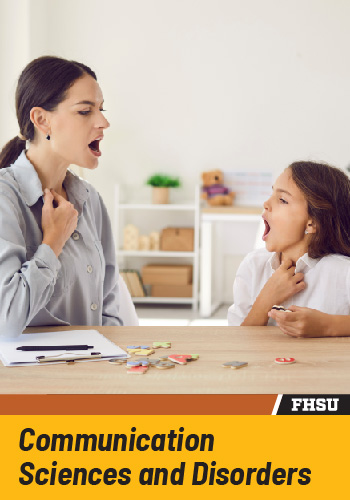
Minor in Communication Sciences and Disorders
Hours: 20 On-Campus Online
The Minor in Communication Sciences and Disorders at Fort Hays State University offers students a comprehensive foundation in speech, language, and hearing science. Available online and on campus, the program complements a student’s primary degree by providing essential knowledge about communication disorders.
The minor requires 20 credit hours, consisting of 12 required credits and eight elective credits, enabling students to customize their coursework according to their academic and professional interests.
Students explore how speech and language develop across the lifespan and examine the effects of various disorders on communication. Core courses include topics like the fundamentals of communication sciences, hearing disorders, language development, and the physiology of speech.
Who is this program for?
This minor is designed for students interested in how communication influences interaction, learning, and well-being. It is ideal for those pursuing careers involving individuals with communication challenges or planning graduate study. Its flexible structure allows students from diverse majors to strengthen their academic and professional credentials.
- Students interested in health or education-related professions
- Psychology majors seeking communication disorder knowledge
- Education majors preparing for inclusive classrooms
- Nursing and health science students pursuing support roles
The Best Value in Higher Education Anywhere
Fort Hays State University prides itself on quality education at an affordable price. Students in this program can expect to pay approximately $3,237.60* (on-campus) or $4,134.75* (online) per semester.
*Estimated cost based on 15 credit hours at the Undergrad resident/regional tuition rate ($215.84/credit hour) for on-campus courses, or the FHSU Online Undergrad tuition rate (275.65/credit hour) for online courses. Actual price may vary depending on course load and location. Tuition and Fees are subject to change as they are approved by the Kansas Board of Regents each year.
The core curriculum provides students with a foundational understanding of communication science. Required courses cover normal and disordered speech and language development, the physiological processes underlying speech and hearing, and the role of hearing science in assessment and intervention.
SLP 160: Introduction to Communication Disorders
An introductory course that provides a foundational overview of speech, language, and hearing disorders, including their characteristics, causes, and common intervention approaches.
SLP 370: Early Speech and Language Development
In this course, students explore the development of communication from birth through the preschool years, focusing on key milestones in phonology, morphology, syntax, semantics, and pragmatics. The course also examines the interplay between cognitive and social skills and reviews major theories of early language development.
SLP 402: Clinical Phonetics
This course examines the perception and production of speech sounds, focusing on their application to the assessment and treatment of speech disorders. Students gain practical knowledge of phonetic principles relevant to clinical practice.
Discover the full Minor in Communication Sciences and Disorders course listing by visiting the Academic Catalog.
The Minor in Communication Sciences and Disorders provides a strong foundation for a variety of professional paths. Whether entering the workforce directly or pursuing further education through a certificate or a bachelor’s degree, students gain skills and knowledge that enhance their effectiveness and competitiveness in communication-focused roles.
Educational Support Specialist
Educational support specialists assist students with speech, language, and hearing challenges within school systems. They collaborate with special education staff, help implement individualized education plans (IEPs), and create supportive learning environments.
Healthcare Communication Aide
Healthcare communication aides support patient care and communication in hospitals and healthcare settings. They assist patients with speech and language impairments, collaborate with therapy teams, and help educate families on effective communication strategies, ensuring patients receive comprehensive and accessible care.
Special Education Paraprofessional
Special education paraprofessionals work directly with children with diverse learning and communication needs. They support speech and language development as part of a collaborative educational team, using knowledge of communication disorders to enhance learning and provide effective, individualized assistance.
Ready for the next step?
Our faculty would be excited to talk to you about how our department programs can help you explore your interests and prepare you for a variety of rewarding careers.
Related Programs
Fort Hays State University offers several complementary programs for students interested in communication sciences, education, and health. These related programs provide opportunities for expanded learning and can pair with the Minor in Communication Sciences and Disorders for broader career pathways:
- B.S. in Communication Sciences and Disorders
- Bachelor of Science in Nursing
- Minor in Psychology
- M.S. in Special Education (Gifted)
- M.S. in Special Education (High Incidence)
- M.S. in Special Education (Low Incidence)
- Certificate in Consumer Health
- Certificate in Speech-Language Pathology Assistant
Students may work as educational aides, healthcare support staff, or pursue further study.
Yes, most courses are available in person and online, offering flexibility for students.
Yes, it complements many degrees, such as education, psychology, nursing, and health sciences.
Yes, this minor could add unique skills to their application to several graduate programs, including related areas such as occupational therapy, special education, or psychology.
Courses often include lab-style activities, video analyses, and practical case-based discussions that simulate real-world scenarios.
Information about the Department of Communication Sciences and Disorders
The Department of Communication Sciences and Disorders at FHSU is dedicated to preparing students to make a meaningful impact in improving the lives of others. Through applied learning and clinical experiences, both undergraduate and graduate programs equip students to become effective, compassionate collaborators in educational and healthcare settings. With a 100% career placement rate over the past three years, the department’s supportive faculty and comprehensive curriculum ensure graduates are well-prepared to succeed professionally while making a difference.
Students begin their professional development through involvement in student organizations, gain practical experience by working with clients at the Herndon Clinic, benefit from small class sizes, and participate in the National Student Speech-Language-Hearing Association (NSSLHA). The programs also offer opportunities for research, faculty mentorship, and external clinical placements, preparing students for rewarding careers across a variety of healthcare environments. Graduates are highly sought after as speech-language pathologists, equipped to make an impact in a variety of clinical and educational settings.
While earning a degree remains the primary focus, college life offers much more than classroom learning. Students are encouraged to participate in extracurricular activities that foster leadership skills, deepen their understanding of their chosen careers, and provide opportunities to make a positive impact in their communities.
- National Student Speech-Language-Hearing Association (NSSLHA): This organization holds monthly meetings and engages in service activities, including sponsoring the Ellis County Spelling Bee. Members also have opportunities to attend state and national conventions. For more information, students may contact Ms. Tara Marshall or Dr. Ran An.
- The residential Master of Science (M.S.) education program in speech-language pathology at Fort Hays State University is accredited by the Council on Academic Accreditation in Audiology and Speech-Language Pathology, a division of the American Speech-Language-Hearing Association.
- Minor
- Bachelor's
- On-Campus
- Online