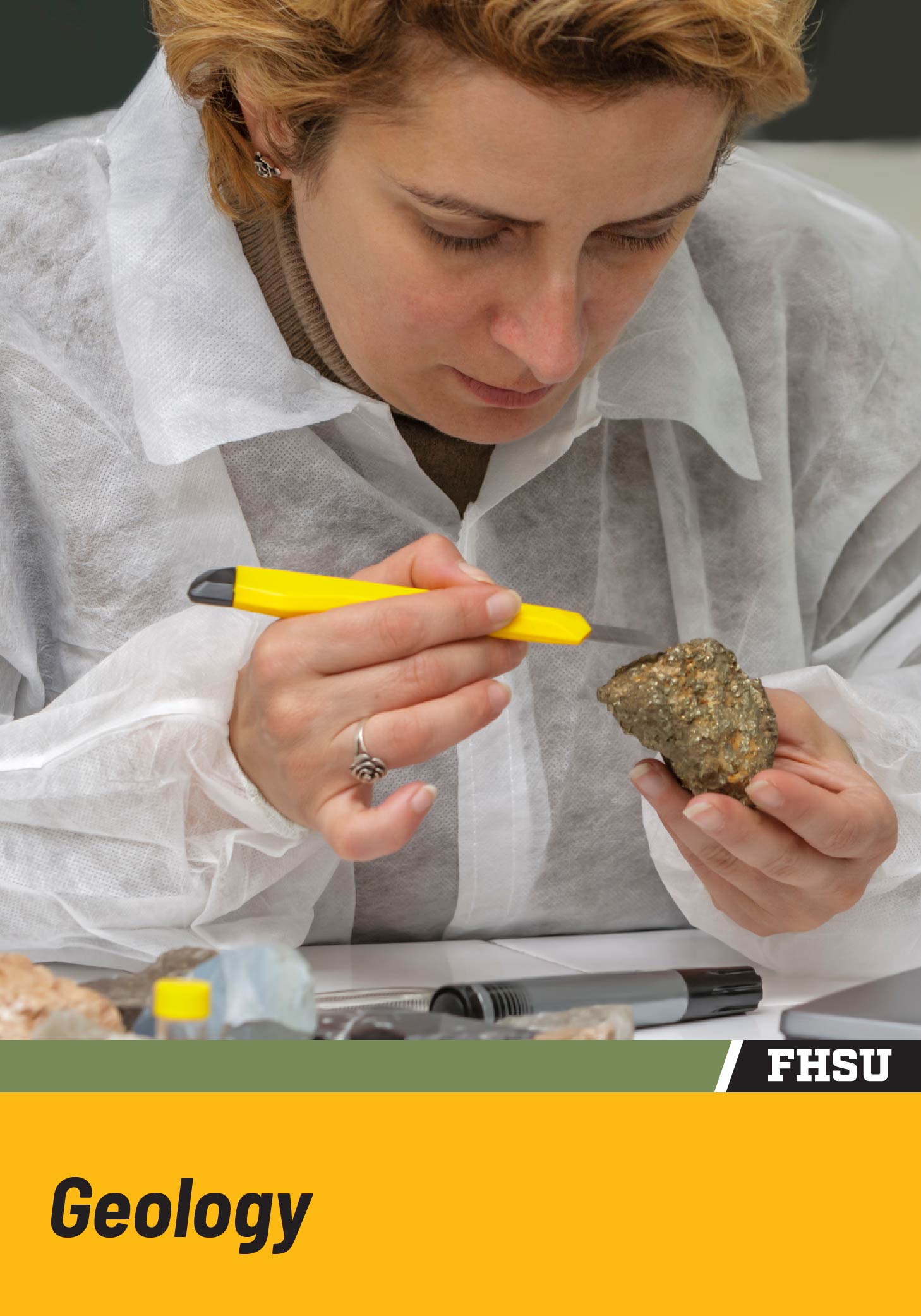
Minor in Geosciences (Geology)
Hours: 20 On-Campus
The Minor in Geosciences (Geology) at Fort Hays State University provides a focused curriculum in Earth sciences for students across diverse academic and career paths. Spanning 20 credit hours, the program covers key geology topics, including physical geology, Earth's evolution, and hands-on laboratory experience. This minor provides a strong scientific foundation for understanding Earth systems, while honing analytical and observational skills, and preparing students for opportunities in environmental studies, the physical sciences, and related fields.
Who is this program for?
This minor serves students seeking to expand their scientific knowledge and add interdisciplinary value to their undergraduate degree. It benefits those interested in Earth sciences as well as students preparing for graduate studies or professional careers in scientific fields.
- Students majoring in biology
- Students majoring in education
- Students in geography or GIS programs
- Engineering students looking to broaden their technical scope
- Business majors with an interest in environmental policy
- Liberal arts students seeking science integration
- Prelaw students focusing on environmental or land use law
- Students pursuing public service or policy careers
The Best Value in Higher Education Anywhere
Fort Hays State University prides itself on quality education at an affordable price. Students in this program can expect to pay approximately $3,237.60* (on-campus) per semester.
*Estimated cost based on 15 credit hours at the Undergrad resident/regional tuition rate ($215.84/credit hour) for on-campus courses. Actual price may vary depending on course load and location. Tuition and Fees are subject to change as they are approved by the Kansas Board of Regents each year.
The core courses provide foundational knowledge and hands-on experience in key geological concepts, starting with physical and historical geology, as well as associated laboratory work. Along with GSCI 100, 102, and 202, students select 12 credit hours of upper-level electives in areas such as hydrology, mineralogy, or geospatial analysis.
GSCI 100: Exploring Earth
Introduction to physical and historical geology. May be taken with or without GSCI 102. May not be taken for credit after GSCI 200.
GSCI 102: Exploring Earth Laboratory
Basic investigation of geologic materials, processes, and methods. Hands-on, active experience with emphasis on observation and measurement. May be taken with GSCI 100 or GSCI 340, but not required.
GSCI 202: Evolution of the Earth
A study of the origin, formation, and development of the Earth and its inhabitants.
Discover the full Minor in Geosciences (Geology) course listing by visiting the Academic Catalog.
Graduates acquire a versatile skill set that enhances their employability across various industries. They develop a practical understanding of Earth’s systems, resources, and processes, expertise that is highly valued in today’s environmentally conscious and technology-driven workforce.
Geologist
Geologists study the Earth’s structure and its materials, including rocks, minerals, and soil. They work in industries such as oil and gas, construction, and government, supporting resource exploration, infrastructure risk assessment, and the analysis of geological hazards like earthquakes and landslides.
Environmental Specialist
Environmental specialists analyze data, ensure regulatory compliance, and recommend sustainable practices to promote environmental conservation. Their geology background supports work in companies, government, and non-profits focused on environmental protection.
Science Educator
Science educators with a geoscience background are well-equipped to teach Earth science, environmental science, and physical science. They support STEM initiatives and inspire future scientists through interactive, data-driven instruction, often incorporating field-based learning experiences.
Urban and Regional Planner
Urban and regional planners utilize geologic and environmental data to guide city design, transportation planning, and zoning decisions. A thorough understanding of soil stability, water flow, and mineral composition is essential for promoting safe and sustainable development at both municipal and regional levels.
Natural Resource Technician
Natural resource technicians assist in conservation and resource management by collecting and analyzing samples of land, water, and air. They play a crucial role in wildlife habitat restoration, forest monitoring, and geological surveys, often collaborating with environmental scientists and policymakers.
Ready for the next step?
Our faculty would be excited to talk to you about how our department programs can help you explore your interests and prepare you for a variety of rewarding careers.
Related Programs
Fort Hays State University offers a range of related programs for students looking to expand their scientific foundation. These options support careers in sustainability, mapping, conservation, and museum sciences, and can be pursued alongside or after completing the Minor in Geosciences (Geology).
- B.S. in Geosciences (Geology)
- Minor in Geosciences (Geography)
- Certificate in GIS User
- Certificate in Museum Studies
- Certificate in Sustainability
Most students complete the minor in two to three semesters, depending on elective choices and course availability.
The minor requires 20 credit hours, consisting of eight credit hours from core courses and 12 credit hours from electives in geosciences.
Depending on the student's major, specific general education courses can also count toward the minor.
Labs include mineral analysis, rock classification, and geologic measurements. Some courses include field trips to local or regional geologic sites.
Yes, it provides scientific skills applicable to K-12 teaching, environmental planning, and roles in natural resource agencies.
Information about the Department of Geosciences
The Department of Geosciences at FHSU provides students with the opportunity to explore the world through scientific and geographical lenses, preparing them for a wide range of careers that enhance our understanding of the planet. Programs, available both online and on-campus, focus on developing critical thinking and perseverance, equipping students with the skills necessary to succeed in fields such as education, government, industry, and research. With a curriculum that integrates rigorous academic study and practical field experiences, students are empowered to shape their own future success.
Faculty, experts in geology and geography, are committed to offering personalized guidance and support throughout students’ academic journeys. Department of Geosciences graduates are highly sought after across various industries, bolstered by a strong and accomplished alumni network. Whether pursuing studies on-campus or online, students can expect dedicated support to help them achieve their academic and professional goals, ensuring they are well-prepared to make a meaningful impact in their chosen fields.
While earning a degree remains the primary focus, college life offers much more than classroom learning. Students are encouraged to participate in extracurricular activities that foster leadership skills, deepen their understanding of their chosen careers, and provide opportunities to make a positive impact in their communities.
- Sternberg Geosciences Club: The Sternberg Geosciences Club is an active organization for students passionate about geology and related sciences. It provides members with opportunities to participate in field trips, attend guest lectures, and engage in hands-on projects that enrich learning beyond the classroom. Club members collaborate on research, explore geological sites, and contribute to community outreach initiatives, fostering both academic growth and community engagement.
- AAPG/SEG Petroleum Club: The AAPG/SEG Petroleum Club is affiliated with the American Association of Petroleum Geologists and the Society of Exploration Geophysicists. It offers students valuable exposure to the petroleum industry through networking events, industry presentations, and participation in national conferences. The club serves as an excellent platform for students pursuing careers in oil and gas exploration and production.
- WiSTEM (Women in STEM): WiSTEM is an inclusive organization dedicated to supporting and empowering women pursuing careers in science, technology, engineering, and mathematics. The club promotes diversity and provides mentorship opportunities, workshops, and networking events designed to foster professional growth for women in STEM fields.
- Honor Society - Gamma Theta Upsilon: Gamma Theta Upsilon is the international honor society for geography. Membership is by invitation and recognizes students who have demonstrated academic excellence in the field. Members gain access to exclusive events, scholarships, and networking opportunities, and frequently participate in service projects that benefit the community.
- Minor
- Bachelor's
- Master's
- On-Campus