Faculty Resources
Resources for AI and Writing
AI Use Guidance & Statements
- WAC Committee Statement on AI—April 2023—a statement on how generative AI affects student writing and some ideas on how to address the use of AI in your syllabus
- AWAC Statement on AI and Writing Across the Curriculum - This statement integrates and revises the conceptual frame words and draft language developed by AWAC. It builds upon the original 2023 statement.
- FHSU Department AI Syllabus Statements - FHSU Departments have provided templates for AI Syllabus Statements. Faculty are encouraged to adopt these statements for the context of their courses.
- Modern Languages Association (MLA) Statement on AI Guidance -This statement of endorsement was drafted by the MLA Task Force on AI in Research and Teaching. The Executive Council approved it as an MLA statement in October 2025. *Please note: The Conference on College Composition and Communication (CCCC) share a joint statement with MLA.
- American Psychological Association (APA) Ethical Guidance for AI -APA’s guidance was developed specifically for health service psychologists who want to ethically integrate AI into their practice. This document offers practical considerations and recommendations tailored to real-world clinical settings.
- Council of Science Editors (CSE) Section 2.1.15 Use of Generative Artificial Intelligence (GenAI) in the Work
- National Councils of Teachers of English (NTCE) - Position Statement: Exploring, Incorporating, and Questioning Generative Artificial Intelligence in English Teacher Education
FHSU Gen-Ed CORE (Common Outcomes for Relevant Education)
- Writing-Related Outcomes
- Rubric Template for proposing a course to meet the upper-level writing outcomes for the Gen-Ed CORE
- Sample CORE Rubric and Assignments: BCOM 695 Corporate Communication
- CORE Overview Materials - This handout should be helpful for departments working on their CORE proposal for meeting the upper-level writing outcomes. Especially, it clarifies what is meant by a "discipline-specific document."
FHSU Rubrics
Watch for this list to grow as the WAC initiative grows and we add writing-related rubrics from across campus.
Developed by the FHSU WAC Committee, this rubric is an optional resource that can help you specify to your students exactly what you expect from a persuasive writing project—and this rubric aligns with the first of the Writing-Related CORE Outcomes. Feel free to adapt the rubric to the specifics of your assignment.
Resources for Incorporating Writing into Your Curriculum
Here’s another page that will grow as the WAC initiative grows and faculty from across campus share handouts and strategies that have worked with their own classes.
- Peer Response Sheet—generic enough for most essays—or adapt it to fit your assignment
- Teaching Guides from the WAC Clearinghouse
- Managing the Paper Load
- Faculty Tip Sheets—everything from preventing plagiarism to managing grammar to sequencing writing assignments
- Effective Writing Assignments (PDD 2020 handout)—tips and a checklist for creating high-quality writing assignment instructions
- WAC and Second-Language Writing
- Writing Circles in STEM: Why Structured Peer Review Engages Students as Writers, Thinkers, and Collaborators in Their Discipline This study explores how students’ perceptions of themselves as thinkers and communicators within a STEM discipline are impacted by structured peer review.
Special TILT Talk Podcasts featuring Writing Resources
Making Writing Meaningful for Our Students with Michele Eodice [co-author of Making Writing Meaningful: A Guide for Higher Education]
AI & Writing with Sid Dobrin [author of AI and Writing]
Giving Feedback on Student Writing with Dan Melzer [author of Reconstructing Response to Student Writing]
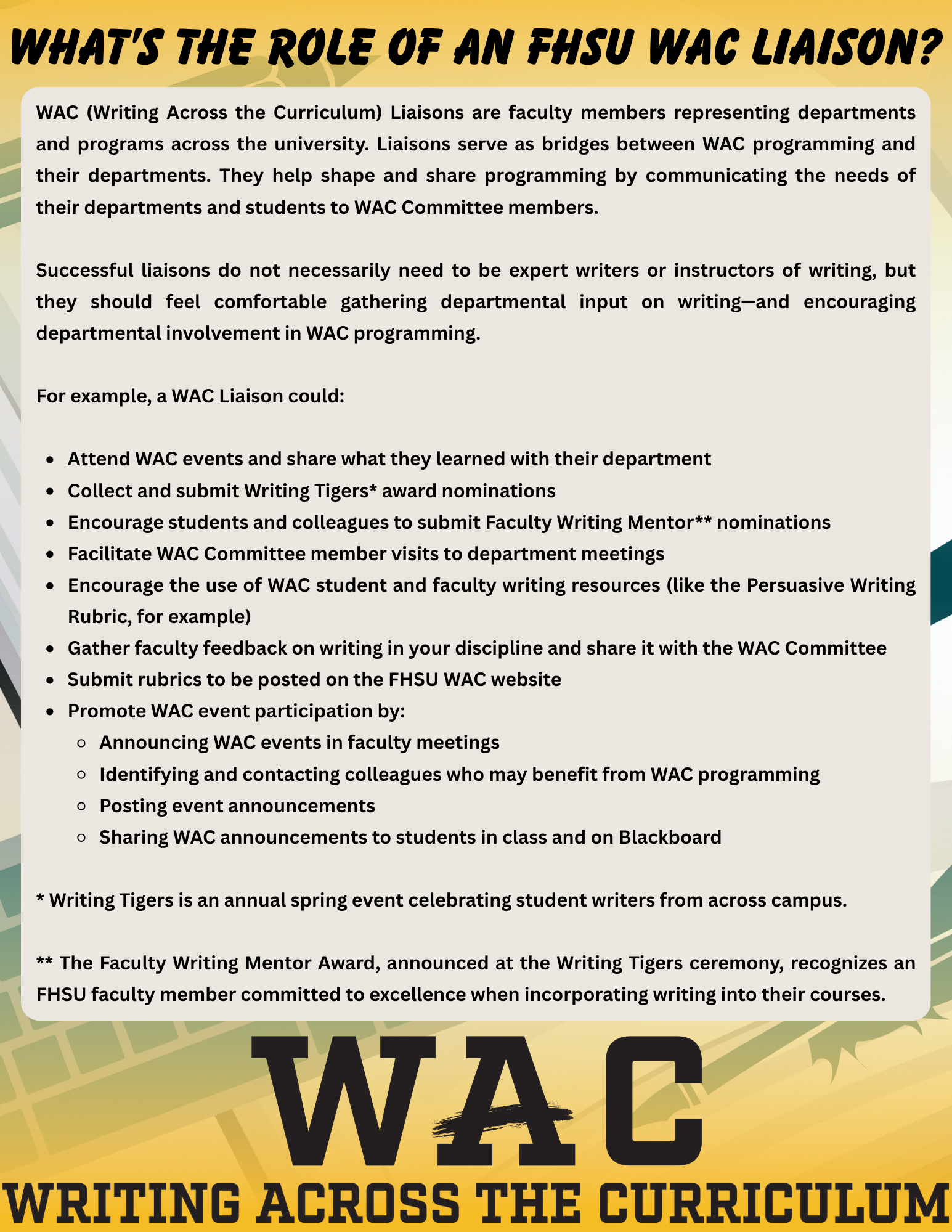
FHSU Departmental WAC Liaisons
Find the designated WAC contact person in your department